
Orbit 1Star
Sun
The heart of our solar system. A G-type main-sequence star containing 99.86% of the system's total mass.
Distance
0 AU (Center)
Diameter
1,392,700 km
Day Length
25 Earth days
Year Length
N/A
Moons
0
Temperature
5,500°C (surface)
Entering Deep Space
Journey Beyond the Stars
Witness the majesty of black holes, traverse the cosmic expanse of our Milky Way, and discover the secrets that lie at the edge of the observable universe.
The Cosmic Frontier
Deep space extends beyond our solar system into the vast cosmic ocean. It is a realm of extreme distances, ancient light, and phenomena that challenge our understanding of physics itself.
Observable Universe
◉The diameter of the observable universe continues to expand
Known Galaxies
✦Each containing billions of stars and planetary systems
Stars in Milky Way
✧Our home galaxy alone hosts an incomprehensible number
Universe Age
⊛Since the Big Bang created space, time, and matter
Deep space is defined as regions of space beyond the gravitational influence of Earth, typically starting at about 2 million kilometers from our planet. But the true deep space—interstellar and intergalactic space—stretches across distances so vast that light itself takes millions of years to traverse them.
In this cosmic void, we find the building blocks of the universe: nebulae where new stars are born, remnants of supernovae that seed the cosmos with heavy elements, and the mysterious dark matter that forms the invisible scaffolding of galactic structure.
The study of deep space has revealed that our universe is not only expanding but accelerating in its expansion—driven by an equally mysterious force we call dark energy, comprising about 68% of the total energy content of the cosmos.
Orbital Atlas
Navigate through each world in our celestial neighborhood. Select a planet to reveal its telemetry data and cosmic statistics.
The heart of our solar system. A G-type main-sequence star containing 99.86% of the system's total mass.
Distance
0 AU (Center)
Diameter
1,392,700 km
Day Length
25 Earth days
Year Length
N/A
Moons
0
Temperature
5,500°C (surface)
Cosmic Enigmas
Black holes are regions of spacetime where gravity is so extreme that nothing—not even light—can escape once past the event horizon.
Telescope View
Accretion disk light bent by extreme gravity around the event horizon.
Event Horizon Imaging
First ever direct observation captured by the Event Horizon Telescope.
The boundary beyond which nothing can escape, not even light. Once crossed, the pull of gravity becomes inescapable.
Superheated matter spiraling into the black hole at near-light speeds, reaching temperatures of millions of degrees.
The theoretical point of infinite density at the center where all known physics breaks down.
Theoretical radiation that causes black holes to slowly evaporate over immense timescales.
5-100 Solar Masses
Formed from collapsed massive stars after supernova explosions
100-100,000 Solar Masses
Rare bridges between stellar and supermassive black holes
Millions-Billions Solar Masses
Found at the centers of galaxies, including our Milky Way
One of the most visually striking effects of black holes is gravitational lensing. The immense gravity warps spacetime so severely that light from objects behind the black hole bends around it, creating distorted, magnified, or multiple images.
This effect, predicted by Einstein's General Theory of Relativity, allows astronomers to detect and study black holes even though they emit no light themselves.
Our Cosmic Home
The Milky Way is a barred spiral galaxy approximately 100,000 light-years in diameter. We reside in one of its spiral arms, about 26,000 light-years from the galactic center.
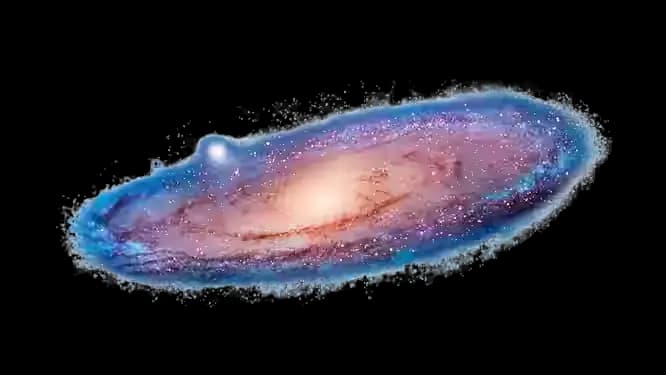
Diameter
100,000
Light-Years
Age
13.6
Billion Years
Stars
200-400
Billion
Dark Matter
~90%
of Total Mass
Region Index
The dense central region containing Sagittarius A*, our galaxy's supermassive black hole with 4 million solar masses.
We orbit in the Orion Arm, a minor spiral arm between the Sagittarius and Perseus arms.
Our nearest stellar neighbor, a triple star system visible from Earth's southern hemisphere.
Home to Sagittarius A*, the supermassive black hole that anchors our entire galaxy.
Establish Connection
Ready to explore the cosmos together? Send us a transmission and we'll respond at the speed of light.